

For the best experience, I recommend reading articles in a web browser or via the Substack app. Duke Basketball Reference is not affiliated with Duke Athletics or Duke University.
2025-2026
Duke Blue Devils | 35-3 overall | 17-1 ACC
ACC Regular Season Champions | ACC Tournament Champions
NCAA East Region 1-seed | NCAA Elite Eight | Final AP Poll #4
“I’m not shying away from the fact that there’s incredible disappointment and heartbreak when you lose the way we did….we’ve lost two unimaginable ways the last two seasons….”
- Coach Scheyer (full interview below)
Season Numbers
Duke won both the outright ACC regular season and the ACC Tournament for the second year in a row. Only 5 times in ACC history has a team won the outright regular season and the ACC Tournament in consecutive years. It hadn’t happened since Duke in 1999-2000, with the rest coming prior 1975.1
855 - points this season for Cameron Boozer, the third best single-season point total in Duke history. His 389 rebounds also rank as the third most in a season. Boozer was the first freshman to average 20 points/10 rebounds/4 assists since Larry Bird in 1977.2
11 - National Players of the Year for Duke (most all-time) with Cam Boozer sweeping the six major awards this season. And if you missed it, my NPOY article from a few years ago is now updated as well.3
5 - combined margin of defeat in Duke’s three losses, with all of the game-winning points coming with under four seconds to go.4
13 - wins for Duke against the AP Top 25, the most ever in a single season.5
DBR Stats
Full Season Stats: Duke Basketball Reference Season Stats
I tracked 19 different statistical categories this season, and included the link in each newsletter. I’m fond of saying that basketball should be considered both “science and art” - with the stats and analytics providing an objective look at trends throughout the year, while keeping in mind the numbers cannot tell the whole story.
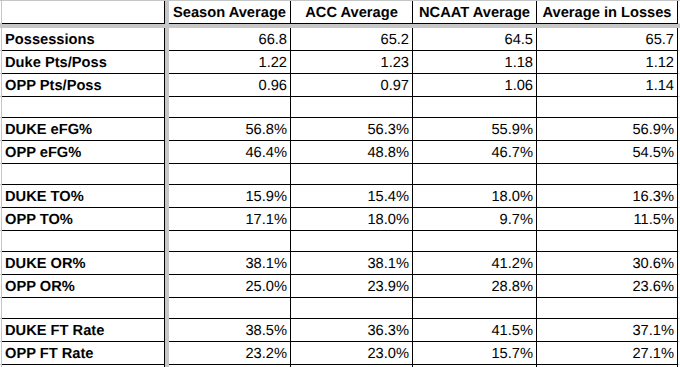
This was best rebounding team so far under Jon Scheyer, and it’s not a stretch to say one of the few best rebounding Duke teams of the analytics era (since 1997). Duke has only had four other teams with an offensive rebounding rate above 38%, and this was the first Duke team to keep their opponents below 28% on the offensive glass.6
At 15.9%, the Blue Devils ranked 135th in the country in turnover rate after being inside the top 35 the previous two seasons (~14%). Duke’s turnover rate was ~2% above their season average during the NCAA Tournament and a touch higher (~0.5%) in their three losses. While those are all small increases (and four NCAA games is not a good sample size), those few additional lost possessions over the course of forty minutes are significant when it’s a one or two possession game at the end.7
Duke did an excellent job keeping their opponents off the free throw line, finishing second nationally in defensive free throw rate, but opponents were able to get to the stripe ~4% more often in losses. A few additional fouls 1) stop the clock, 2) potentially put guys in foul trouble, and 3) put the opponent in the bonus more quickly.
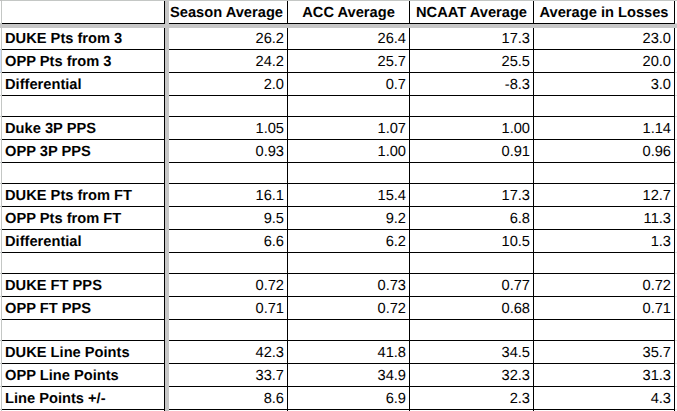
If you’ve been reading for a while, you know I’m fond of line points as a key metric (points from 3 + points from FT). Obviously, all points count the same, and Duke was dominant from two-point range this season, shooting 60.2% inside the arc (7th nationally) while generating 1.21 points-per-shot and outscoring teams by ~9.5 points per game on twos. The majority of Duke’s advantage in line points came from free throws, with three-point scoring virtually even on the season. Opponents only shot 30.6% from three-point range on the year, but made 11 of 14 triples down the stretch in Duke’s three losses.8
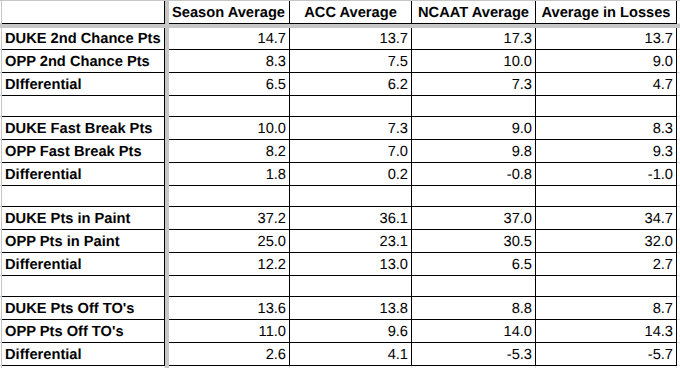
After Duke’s win over Wake Forest in January, Jon Scheyer remarked “Rebounding was our advantage for this game. It is our advantage probably most games….I never thought we'd be playing ‘smash mouth’ basketball as much, but it’s a fun style when you’re getting layups and dunks and fighting for great shots.” The Blue Devils pounded teams inside for a season-long advantage in second chance points (+6.5) and points in the paint (+12.2), along with their rebounding rate mentioned earlier. I already noted Duke’s turnover rate as well - that marginal increase showed up not only in lost possessions, but also in points off turnovers for the opponent.
Of course, the most important statistic is always wins. Duke’s 35 victories was behind only Michigan (37) and Arizona (36).
Season Analytics
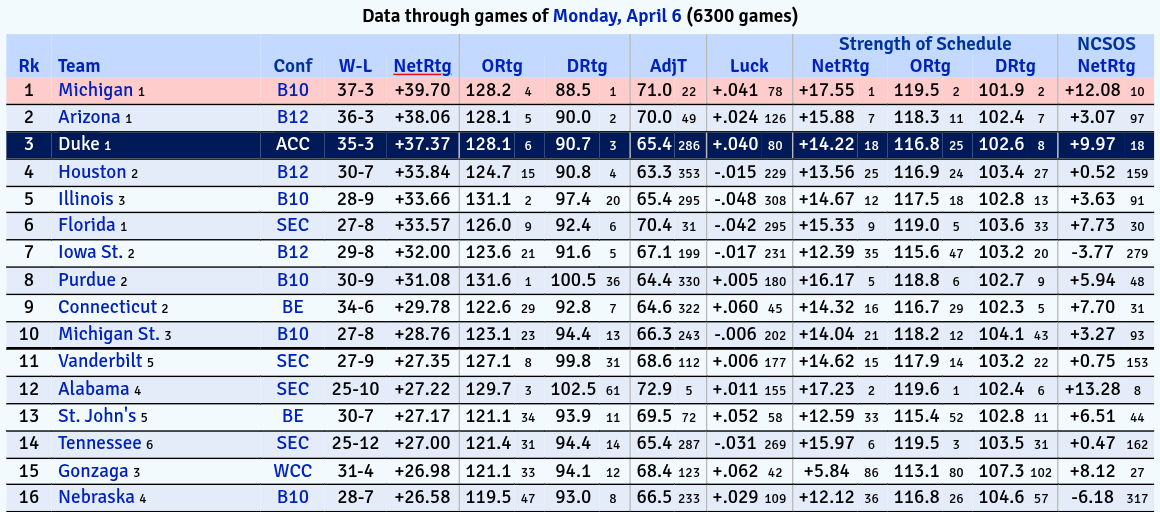
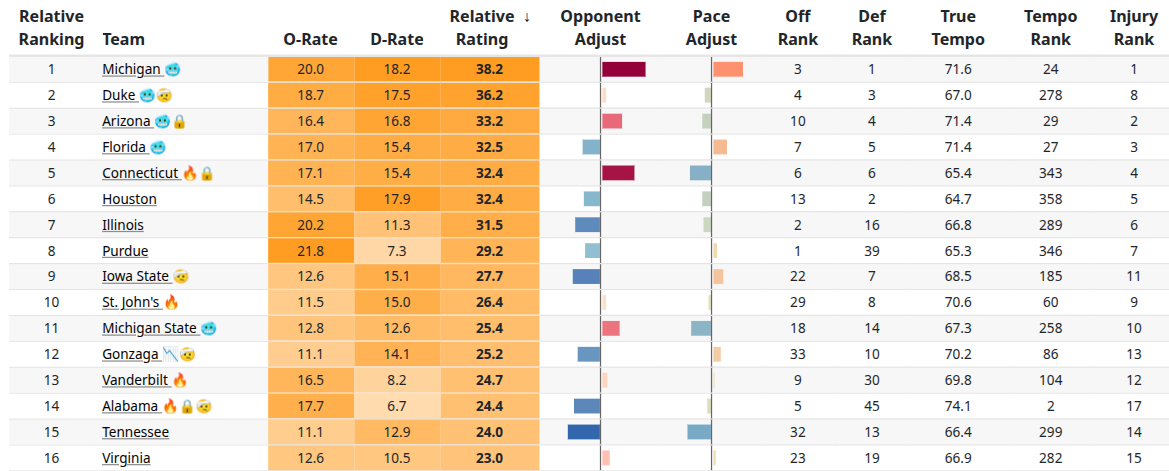
Duke finished #3 in Ken Pomeroy’s final rankings (+37.37), with the 6th best offensive rating (128.1) and 3rd best defensive rating (90.7). Via Evan Miyakawa, the Blue Devils finished #2 overall (+36.2).
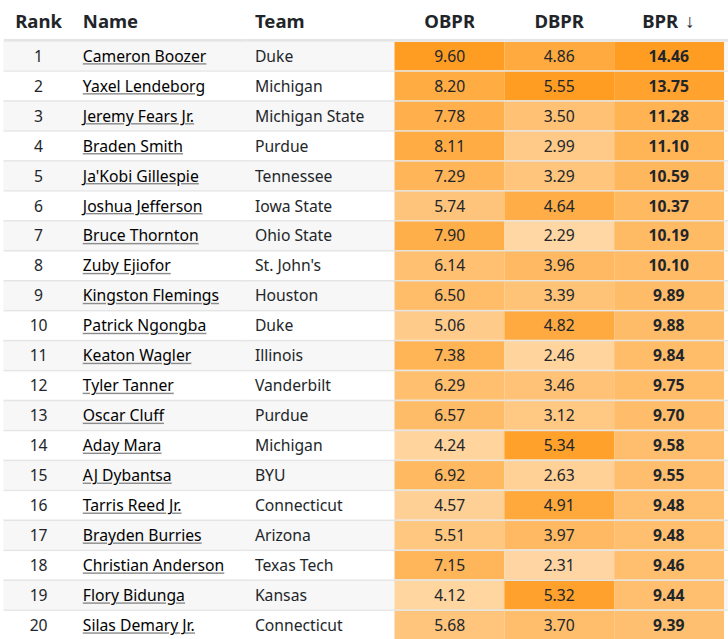
Evan Miya also debuted a new player performance rating this season. It’s no surprise the analytics support the NPOY hardware for Cam Boozer. But what went under the radar to most was Pat Ngongba’s impact on both ends of the floor for Duke. Pat finished second on the team in offensive rating (126.6), fourth in assist rate (16.9%), and first in blocked shot rate (6.0%).9
Lineups
I enjoyed including more lineup analysis in the newsletter this season though, of course, statistics like plus/minus or on/off comparisons do not illustrate the full picture.10 Here is every Duke lineup with 75+ possessions on the season, and it’s noteworthy that no five-man combination appeared in more than 30 games.
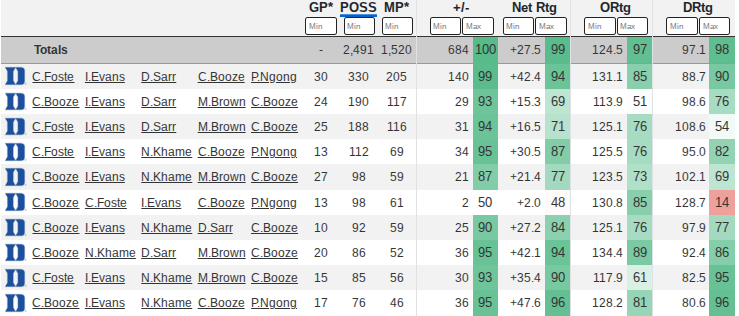
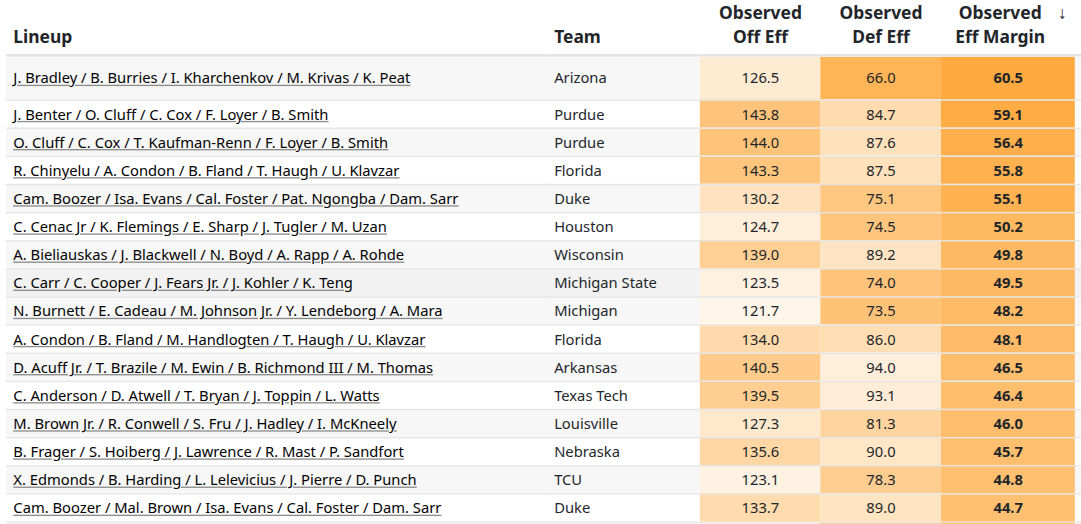
In fact, Duke had two of the top lineups in the country according to EvanMiya (150+ possessions). Unfortunately, Duke’s best lineup was only able to log 330 possessions on the year. For context, Arizona’s top combo was on the floor for over 750 possessions, Houston’s for over 600 possessions, and Michigan’s for over 450 possessions.
More Season Numbers
3 - consecutive Elite Eight appearances for Duke for the first time since five in a row from 1988-1992. The list of coaches with three Elite Eight appearances before age 40: Bob Knight, Dean Smith, and Jon Scheyer.11
35 - wins for Duke for the second year in a row. The Blue Devils are 70-7 in the last two seasons, the most wins in a two-year period in Duke history.12
124 - career wins for Jon Scheyer, the most all-time by a coach in their first four seasons.13
0 - losses for Duke at home. The Blue Devils are 63-3 in Cameron under Coach Scheyer, including three undefeated seasons.
58.8% - assist rate for the Blue Devils on the season, the second best mark since Duke began tracking assists in 1968-1969. Here are my favorite Duke dimes of the ACC regular season, originally posted in DBR Newsletter #102.14
25 - years since Duke won the 2001 National Championship. The squad got together in Cameron for the SMU game, and I wrote my longest article thus far to celebrate the 25th Anniversary.

“I’m not shying away from the fact that there’s incredible disappointment and heartbreak when you lose the way we did….we’ve lost two unimaginable ways the last two seasons…and the scarier thing is if we’re not close. The thing is, we’re knocking at the door, we’re right there and we’ve just got to continue to find ways to win in the margin, regroup with a different team for next year, and not quit. Like we’re going to stay at it, we’re going to stay at it until we’re there….this team deserves to praised for the year they’ve had, 35-2 with the schedule we had going into that game. Incredible. And they were a great group to coach.”
Well said, Coach.
Thanks for reading and, as always, Go Duke!
ACC teams to win the regular season outright and the ACC Tournament in consecutive seasons:
Duke (2025-2026)
Duke (1999-2000)
NC State (1973-1974)
North Carolina (1967-1969)
Duke (1963-1964)
Most points in a single Duke season:
964 - J.J. Redick (2006)
860 - RJ Barrett (2019)
855 - Cam Boozer (2026)
841 - Jay Williams (2001)
831 - Dick Groat (1951)
Most rebounds in a single Duke season:
476 - Bernie Janicki (1952)
402 - Mike Lewis (1968)
389 - Cam Boozer (2026)
385 - Randy Denton (1971)
384 - Shelden Williams (2006)
Bird put up 32.8 points/13.3 rebounds/4.4 assists as a freshman at Indiana State. Larry Legend indeed…
Cooper Flagg and Cam Boozer are now join Duke’s list of the schools with at least three players win a NPOY award. And shout out to Zach Edey, who joined the list of players to win NPOY in multiple seasons.
To be exact, it was 3.4 seconds, 0.4 seconds, and 0.4 seconds respectively.
Kentucky (2003) and Indiana (1993) each had 12 wins against the AP Top 25.
Duke OReb Rate (since 1997):
44.3% - 1999
39.5% - 1998
39.8% - 2010
38.8% - 2018
38.2% - 2026
Duke TO Rate: 15.9% in 2026 (135th); 14% in 2025 (18th); 14.4% in 2024 (33rd).
Meanwhile, Duke’s NCAA opponents took good care of the ball with an under 10% turnover rate.
Texas Tech went 3 for 4 from three in the final 6:12; UNC went 3 for 3 from three in the final 2:30; UConn went 5 for 7 from three in the final 7:00.
I have an unwritten rule that I don’t really mention injuries in these newsletters (I also won’t swear that I haven’t broken that rule), but I try not to bring injuries into my recaps or analysis. Every team deals with injuries to varying degrees of severity, number of games missed, point in the season, etc. And especially as a fan, I never want to come across as making an excuse. It goes without saying that losing two starters on the last day of the regular season was less than ideal for Duke (see lineup data as well). Caleb Foster’s return was nothing short of miraculous, and I will never forget his second half performance against St. John’s, but Pat never made it back to anywhere close to full strength either. I feel terrible for both guys and the team as a whole - and applaud the toughness to play while needing to use scooters in between games.
My favorite example of this is from last season, when Duke technically had a better offensive rating when Cooper Flagg was OFF the floor - but there’s no chance anyone believed the Blue Devils were better offensively when he was sitting.
Additional historical context: Coach Smith reached 3 Elite Eights from 1967-1969, and Coach Knight did it in 1973 and 1975-1976. Smith and Knight only needed one NCAA win to reach their Elite Eights from 1967-1974, and Knight only needed two NCAA wins in 1975-1976. And of course, Coach Smith had to win the ACC Tournament to reach the NCAA’s during his early run.
Most wins for Duke in a two-year period:
2025-2026 (70-7)
1998-1999 (69-6)
2010-2011 (67-10)
1991-1992 (66-9)
1999-2000 (66-7)
2001-2002 (66-8)
Most wins for a coach in their first four seasons:
124 - Jon Scheyer
117 - Brad Stevens
112 - Tommy Lloyd
105 - Mark Few
103 - Shaka Smart
Highest assist rates for Duke in a season: 1992 (58.9%); 2026 (58.8%); 1989 (58.8%); 2025 (58.5%); 1987 (57.9%); 2018 (57.6%); 2001 (57.6%)