

For the best experience, I recommend reading articles in a web browser or via the Substack app. Duke Basketball Reference is not affiliated with Duke Athletics or Duke University.
Four Factors
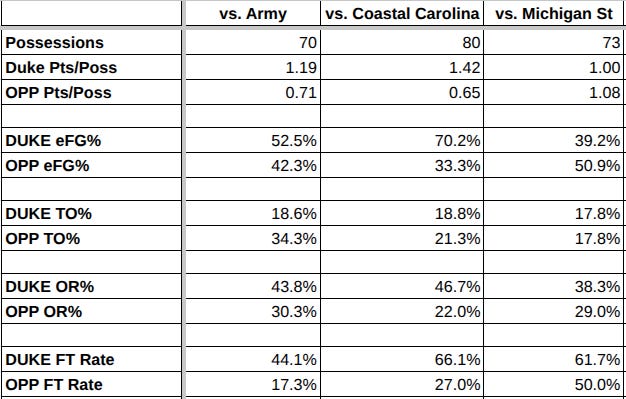
Three games is obviously too small of a sample size to draw any meaningful conclusions, but the two items that stand out for me are Duke’s effective field goal percentage and their opponent’s free throw rate. Prior to the loss Tuesday night, Duke had posted an effective field goal percentage below 40% just once in the previous three seasons.1 Duke shot 25.9% from the field in the first half against Michigan State, including 2 for 12 from beyond the arc. Duke also put the Spartans on the free throw line at a 50% rate, with MSU converting 22 of 28 free throws (including 17 FTA for Jeremy Fears) - the Blue Devils committed 14 of their 21 fouls in the second half.
Lineups
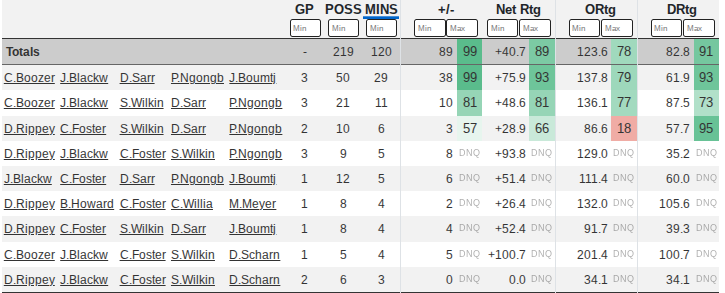
Here are Duke’s most used lineups through three games (again, small sample size). I’m not super interested in the rating metrics so early in the season, but I do like to see which five-man combinations have been on the floor most often. Only three lineups have been used in all three games, and Coach Scheyer has mentioned that minutes and rotations will continue to evolve throughout the year.
Ken Pomeroy includes a depth chart in his analytics, noting the percentage of minutes at each position.2

Champions Classic
After the loss to Michigan State, Coach Scheyer remarked “We did not, the whole night, just play through any resistance. They’re physical, they have great experience, and I thought that showed tonight - and we weren’t able to get to the next action. The amount of times we just went one-on-one against a set defense, put our head down, got our shot blocked, turned the ball over - I thought that’s how they got separation….they have a great defense, that’s what they do. I’m still disappointed in our ability to fight for the rim and fight for better shots.”
Credit the Spartans for their help defense, active hands, and physicality on the defensive side of the ball - I thought Michigan State played terrific.
Jon Scheyer also referenced needing better connectivity on offense - with too much one-on-one, especially when the Spartans put two (or more) on the ball. While watching the film, I noted twelve Duke possessions in the first half with two passes or less. And while ball movement alone does not equal a good shot, Duke needed to work for better looks offensively instead of forcing the action against Michigan State’s defense - the Spartans are one of three teams with a defensive rating below 90.0 per KenPom.3
Clip #1 (below): A - John Blackwell drives into the lane against three defenders after just one pass. B - Caleb Foster is denied at the rim (0 passes). C - Dame Sarr drives into traffic and leaves his feet to make a play (one pass) - MSU converts a transition triple off the turnover.4
It’s also important to point out that Duke generated some great looks via excellent ball movement, even on possessions with fewer passes.
Clip #2 (below): A - John Blackwell drives after coming off a couple of screens, draws Rippey’s defender, and kicks it for the open corner three (2 passes) - also credit Sebastian on the offensive glass. B - After good ball and player movement in the first part of the possession, Deron Rippey drives, draws three defenders, and finds Caleb Foster for an open corner three (6 passes). C - Rippey hits Drew Scharnowksi on the short roll. With three defenders on him, Drew finds CFos open again for three - it spins in and out (4 passes). D - Foster draws a crowd on the back cut and finds Dame in the corner - Sarr makes the extra pass to Cayden Boozer, but his three also spins in and out (4 passes). E - After multiple help defenders cut off his drive, Deron Rippey finds Caleb Foster for a three-pointer (1 pass). F - The best possession of the night in terms of ball movement (8 passes) leads to an open corner three for Sebastian Wilkins.
It’s not so much about the total number of passes, though I did find that exercise helpful on the re-watch, but more so about reading the aggressive help defense. The ball has to move quickly and decisively in order to get the best shot possible against a terrific defensive team.
Paint Shooting
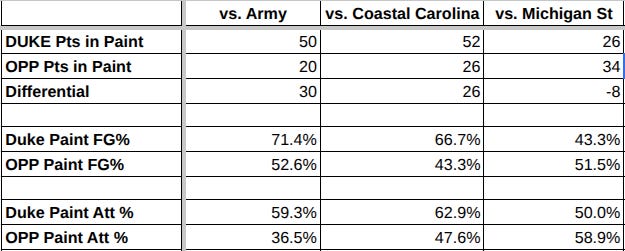
I’m tracking a few new statistics this season - points per offensive rebound and points per turnover, along with additional details on paint points to include shooting percentage and the percentage of field goals attempted. Against Michigan State, Duke shot just 43.3% inside the lane (13 for 30), with only 50% of their attempts coming in the paint. All shots in the paint are not equal in terms of quality, and there is no perfect formula - for example, both the opponent and the game flow influence shot selection. It will be interesting to see how these stats shake out over the course of the season, particularly the shot distribution between paint attempts and three-point attempts.5
Thanks for reading, Go Duke!
Duke posted a 36.4% eFG in the 2024 Elite Eight. The Blue Devils had not posted an eFG below 42% since, until Tuesday against MSU.
If you’re not familiar with KenPom’s lineup data - the border thickness represents a player’s usage rate (thicker = higher) and the green shading indicates a player’s true shooting 3-point attempt rate (darker = higher).
Defensive Rating Leaders (prior to games on 11/12/26): Houston (87.4); Kansas (88.9); Michigan State (89.9) - though still a small sample size.
To be clear, I’m not picking on these three guys - there were several other possessions with two passes or less. Seven different Blue Devils were credited with at least one turnover, and I love the aggressive mindset to drive the ball.
Duke 3-point Attempt % (3PA): vs. Army (37.3%); vs. Coastal (35.5%); vs. MSU (48.3%)