

For the best experience, I recommend reading articles in a web browser or via the Substack app.
Dean Smith would have celebrated his 94th birthday last week, and it’s hard to believe 10 years have passed since basketball lost, as Dick Vitale used to say, the “Michelangelo of coaching.” Thanks to my dad, I’ve been watching ACC basketball since the late-1980’s and, even though I became a Duke fan, it was (and still is) easy to admire and respect Coach Smith. Dean and his program were known for things like pointing to the guy who gave the assist,1 having the bench stand for the man coming out of the game, and putting up a fist to signal needing a break - and for winning.
Upon his retirement in October of 1997, Dean was the winningest college basketball coach of all-time with 879 career victories, and Coach Smith’s accomplishments are still as impressive as they were 30 years ago. If you’ve read some of my other articles, you know I’m not a huge fan of Mount Rushmores or GOAT debates - and that’s not the intention here - I simply love studying the history of the game, and wanted to take a look back at some numbers from Smith’s career.2
Wins
1,202 - Mike Krzyzewski
1,116 - Jim Boeheim
903 - Roy Williams
902 - Bob Knight
880 - Rick Pitino
879 - Dean Smith
Final Four Appearances
13 - Mike Krzyzewski (‘86, ‘88, ‘89, ‘90, ‘91, ‘92, ‘94, ‘99, ‘01, ‘04, ‘10, ‘15, ‘22)
12 - John Wooden (‘62, ‘64, ‘65, ‘67, ‘68, ‘69, ‘70, ‘71, ‘72, ‘73, ‘74, ‘75)
11 - Dean Smith (‘67, ‘68, ‘69, ‘72, ‘77, ‘81, ‘82, ‘91, ‘93, ‘95, ‘97)
9 - Roy Williams (‘91, ‘93, ‘02, ‘03, ‘05, ‘08, ‘09, ‘16, ‘17)
8 - Tom Izzo (‘99, ‘00, ‘01, ‘05, ‘09, ‘10, ‘15, ‘19)
ACC Championships
30 - Dean Smith (17 regular season; 13 tournament)
28 - Mike Krzyzewski (13 regular season; 15 tournament)
12 - Roy Williams (9 regular season; 3 tournament)3
Olympic Gold Medal and NCAA Title
Pete Newell (Gold - ‘60; NCAA - ‘59)
Bob Knight (Gold - ‘84; NCAA - ‘76, ‘81, ‘87)
Dean Smith (Gold - ‘76; NCAA - ‘82, ‘93)
Mike Krzyzewski (Gold - ‘08, ‘12, ‘16; NCAA - ‘91, ‘92, ‘01, ‘10, ‘15)
NIT and NCAA Title
Adolph Rupp (NIT - ‘46; NCAA - ‘48, ‘49, ‘51, ‘58)
Pete Newell (NIT - ‘49; NCAA - ‘59)
Al McGuire (NIT - ‘70; NCAA - ‘77)
Joe B. Hall (NIT - ‘76; NCAA - ‘78)
Dean Smith (NIT - ‘71; NCAA - ‘82, ‘93)
Bob Knight (NIT - ‘79; NCAA - ‘76, ‘81, ‘87)
Nolan Richardson (NIT - ‘81; NCAA - ‘94)
Jim Calhoun (NIT - ‘88; NCAA - ‘99, ‘04, ‘11)
John Calipari (NIT - ‘02; NCAA - ‘12)
Basketball School
Watching Coach Smith work the sidelines in person at my first several ACC Tournaments (and his last several) was very cool, and I was always interested in learning about coaching philosophy and strategy. My dad had this book on the shelf in our living room (it’s on my shelf now), and I can remember looking through the pages in middle school.
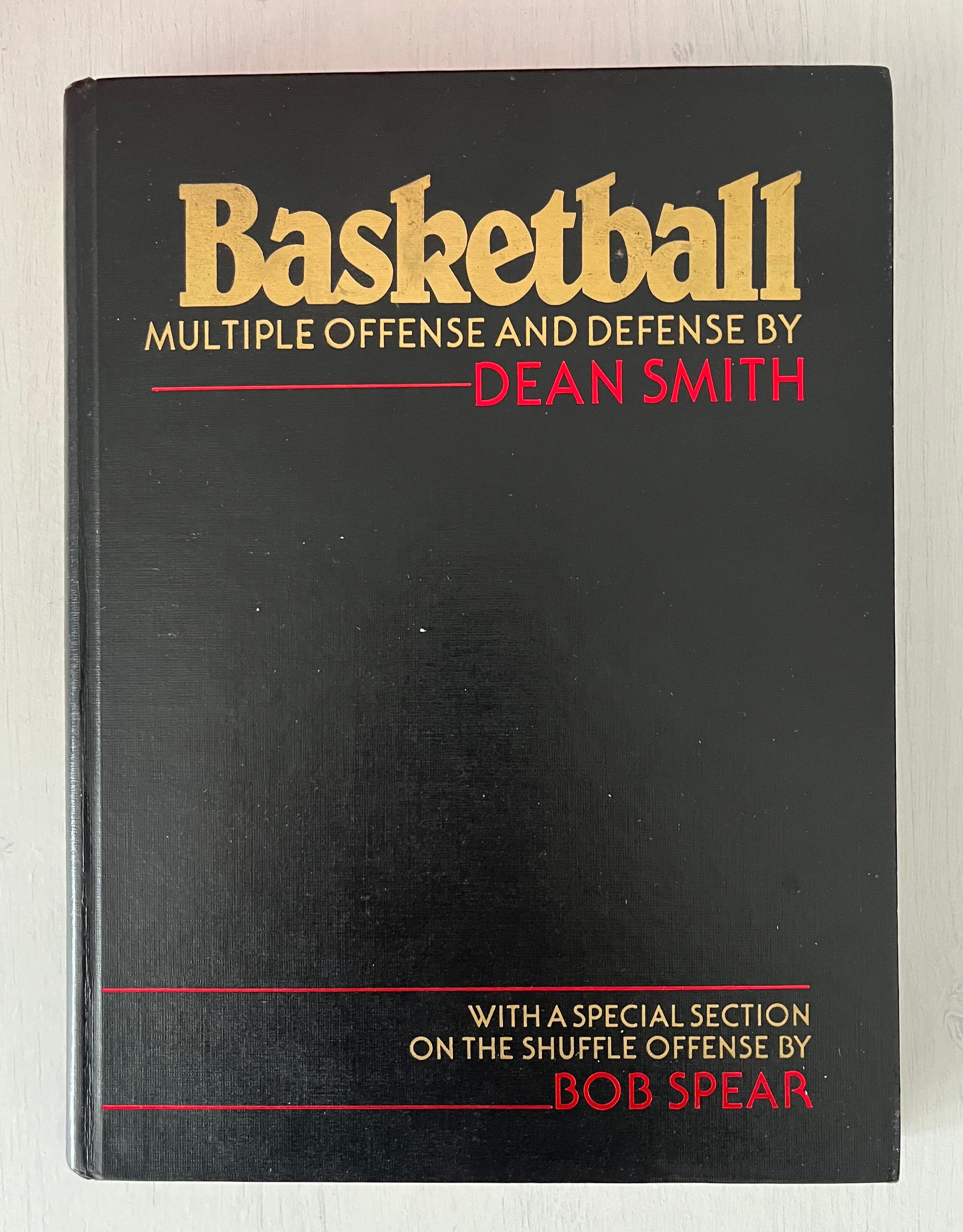
The attention to detail blew my mind. Dean Smith had seemingly thought of everything: flexible versus systematic coaching philosophy (he considered himself slightly toward the flexible end of the coaching spectrum), jump ball situations (now obsolete thanks to the possession arrow), when to hold for the last shot, baseline out of bounds plays, shot selection, fast break versus ball control (he believed the advantages of the fast break outweigh the disadvantages), and on and on. I read it more thoroughly when I was a young high school assistant, and really enjoyed looking back through it for this article. Here are a few of my favorite takeaways:
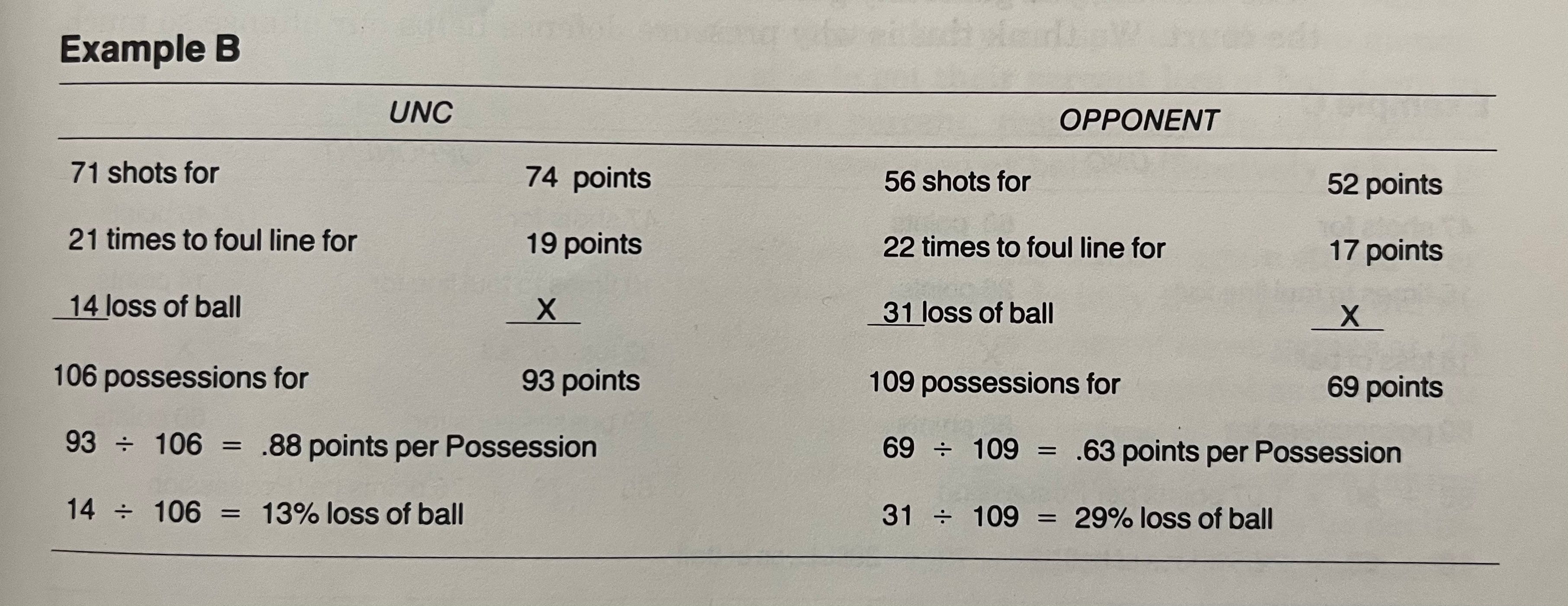
Reading Coach Smith’s book was the first time I became aware of the concept of points-per-possession. His introduction discusses the idea of points-per-possession being a more valuable metric than total points scored or allowed, noting for example “From a defensive point of view, one of my pet peeves is to hear a team referred to as the ‘defensive champion’ strictly on the basis of giving up the fewest points per game over a season. Generally, a low-scoring game is attributable to a ball-control offense rather than a sound, successful defense.” Smith’s goal offensively was at least 0.85 points-per-possession, while holding opponents to 0.75 points-per-possession or less. Of course today, he would update these targets to reflect the three-point shot (adopted for the 1986-1987 season).4 Here’s an example of how the Tar Heels used to chart possessions.
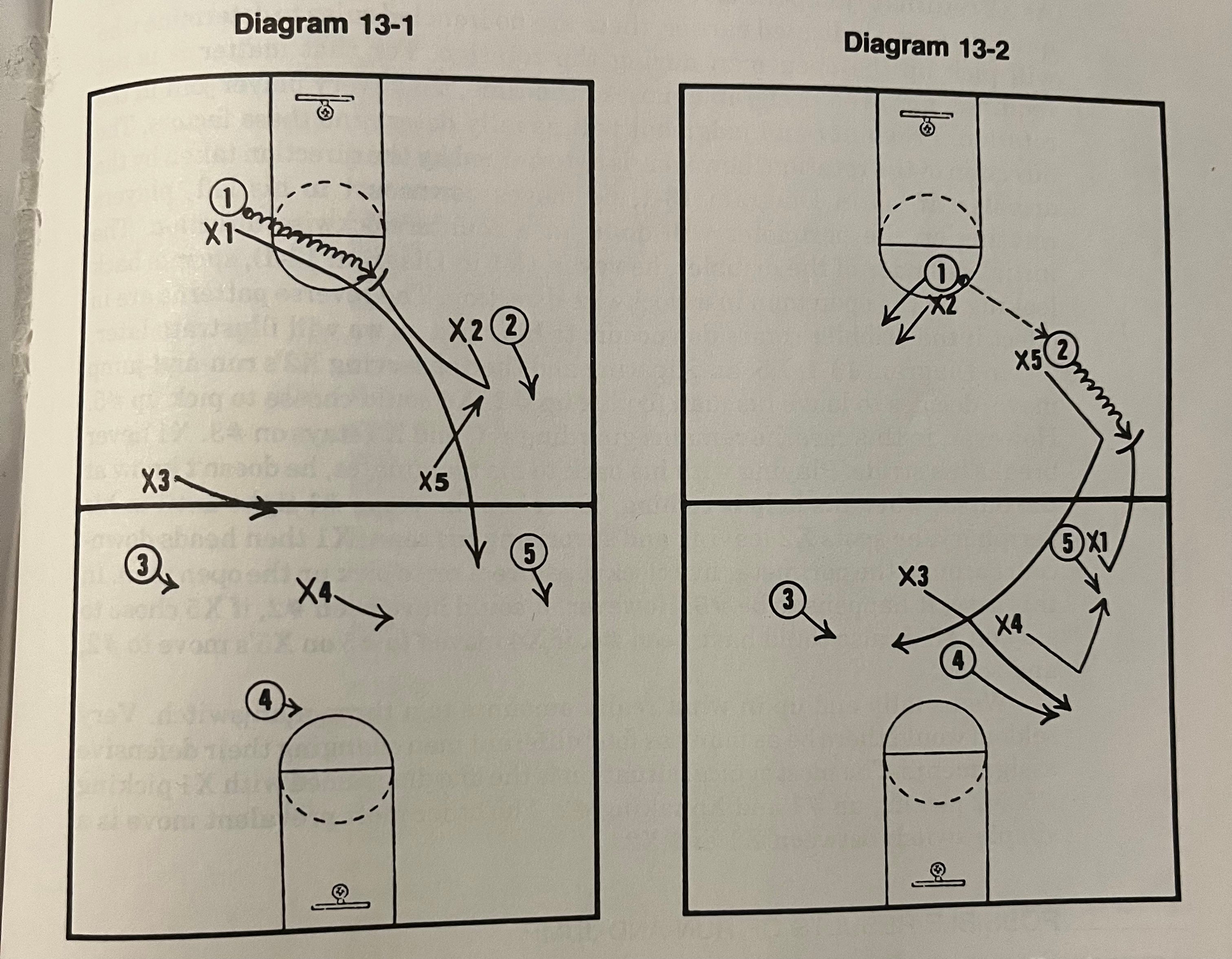
Basketball Multiple Offense and Defense is a simple, yet accurate title - the key word being multiple. Offensively, Coach Smith covers the fast break, the secondary break, the 1-4 game, the T-game, the free-lance passing game, press offense, and of course, the Four Corners. Defensively, he has sections on pressure man-to-man (20 series), various zone looks in the full and half courts (40 & 50 series), and my favorite, the Run-and-Jump. Smith cites the origin of the run-and-jump back to his days as a player at Kansas, though he notes that “run-and-surprise” may have been a more accurate name, and that Coach Morgan Wooten adopted it at DeMatha High School but called it his “blitz” defense. Essentially, the defender one pass away will wait until the ball handler dribbles in his direction, before leaving his man to run at the ball. The other four defenders rotate out and up to take away the next pass(es).
The final chapter is entitled “Practice Planning and Organization.” Again, the attention to detail blew my mind as a young coach. Dean talks about using peer pressure as a motivator in practice (i.e. don’t let your teammate down), pre-practice stations, late game situations (he often utilized a five-minute overtime scrimmage to end practice), and conditioning sprints as a method to build mental toughness. Coach Smith provided detailed examples of his practice planning for the entire season, for each week, and for individual practices (down to the minute). He knew at what point in the season he wanted to install certain offenses and defenses, when to add variations, and how to balance individual versus team development.
“I think Dean is the best teacher of basketball that I have observed.” - John Wooden
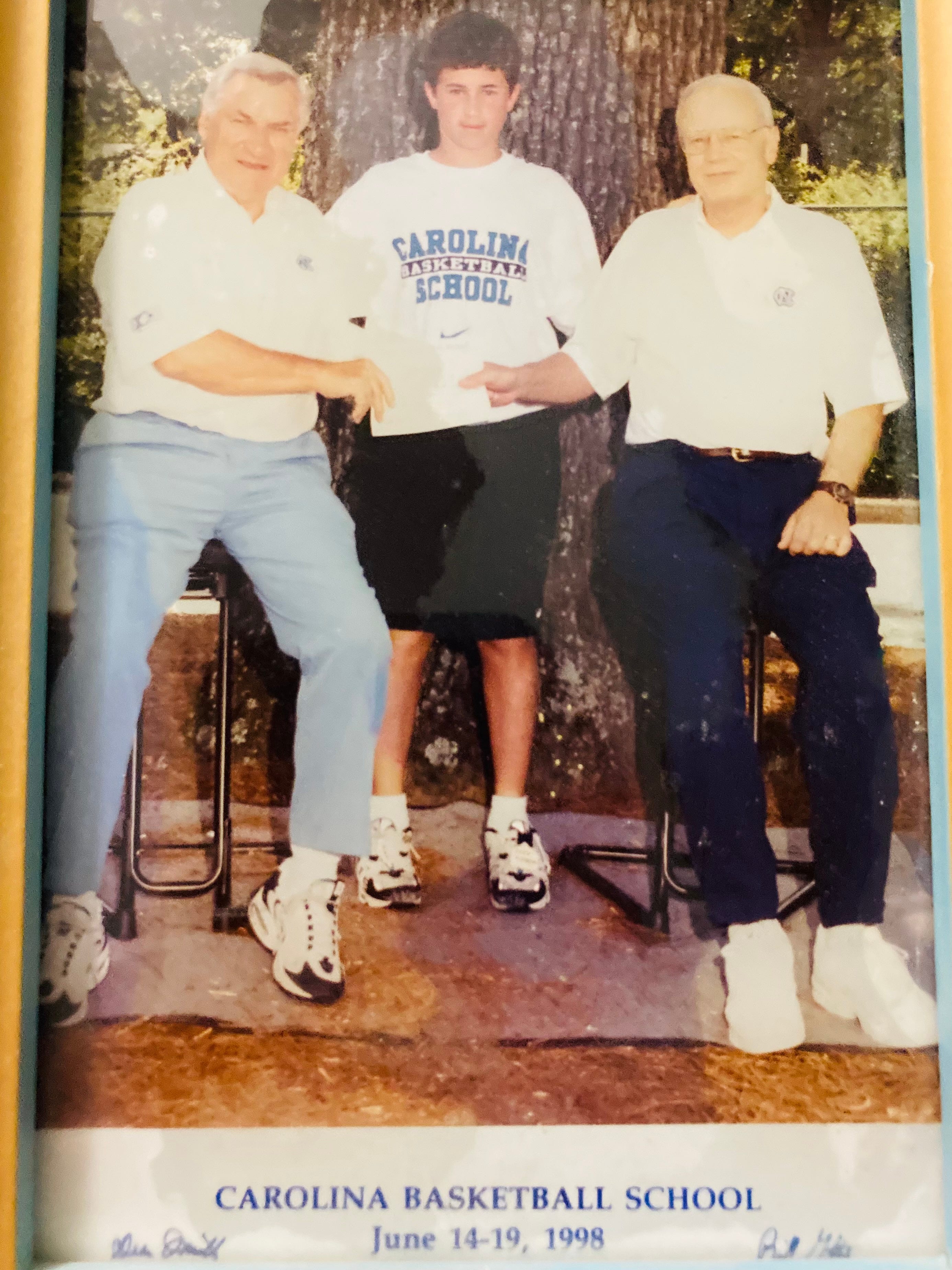
Dean Smith was known as a terrific teacher of the game. In fact, if you were a kid at his camps, you actually didn’t go to basketball camp at all - you went to Carolina Basketball School. My buddy and I spent a week in Chapel Hill in the summer of 1998 (don’t worry, I still wore my Duke gear). Campers were divided into groups to move through drills and play competitive games, and each day around lunch time one group got do layup lines in the Dean Dome. Coach Smith had retired the previous summer, but he still took the time to take a formal picture with every single kid. Here’s my buddy from that week in June:
Rivalry Respect
In the summer of 2005, Jerry Colangelo had recently been named the new Director of USA Basketball, and was tasked with choosing a coach to help regain the gold medal for the United States. Colangelo brought together a group of former players and coaches with Olympic experience to discuss the essential qualities of Team USA’s next coach. Guys like Chuck Daly, Larry Bird, Michael Jordan, Lenny Wilkens, and Jerry West gathered for a meeting and, at some point, it was Dean Smith who said “Mike should have it,” recommending Coach K as the man to lead Team USA. Colangelo remembered “…when Coach Smith told us that no one will connect with and motivate the players like Coach K, the whole crowd was silent. That was a big moment for all of us.” The rest, as they say, is history. Team USA went 88-1 during Coach K’s tenure, winning 3 Olympics and 2 FIBA World Cups.
“I am incredibly saddened to hear of the passing of Coach Dean Smith. We have lost a man who cannot be replaced. He was one of a kind and the sport of basketball lost one of its true pillars.” - Mike Krzyzewski
Duke and North Carolina played yet another classic game in February of 2015, just 11 days after Coach Smith passed away. The great moments in this rivalry are too many to count, and I previously wrote about some of my favorite games. But this moment that took place prior to the 2015 game in Cameron should always be remembered.
After taking over at age 30 for Frank McGuire prior to the 1961-1962 season, Coach Smith went 66-47 in his first five years. North Carolina would win the ACC regular season, the ACC Tournament, and advance to the Final Four in each of the following three seasons. Dean would finish his career in similar fashion, tallying 4 Final Fours and 5 ACC titles from 1990-1997. He coached Jordan, Worthy, Perkins, Daugherty, Smith, Montross, Wallace, Stackhouse, Williams (x2), Cota, Carter, and Jamison - just to name a few.5
Dean won his first NCAA Championship in his 21st season (1982),6 and led his team to the Final Four in both 1967 (23 teams in the field) and 1997 (64 teams in the field). At Kansas, Dean Smith played for Phog Allen,7 who played for James Naismith - you literally cannot write the history of basketball without Dean. He and Mike Krzyzewski became great friends, with the success of their two programs helping them better understand one another. A few years ago, Coach K remarked, “When we went to Final Fours, and won, I knew him. I didn’t know him until I did that. And he knew then that I knew him. And then I could appreciate his genius, just how damn good he was. And he recognized that, eventually, in me. And I love Dean Smith. And I respect the hell out of him.”


Thanks for reading, Go Duke!
This is one of my favorite things in basketball. Being on either end of that assist-pointing exchange is the best feeling in hoops.
I was in the eighth grade when Smith retired - admittedly, I was less of a basketball historian back then. And with the exception of Coach Hall, every other coach mentioned in this section is a Hall of Famer.
Roy Williams won 13 conference titles during his time at Kansas (9 regular season; 4 tournament).
In other words, 2.00 points-per-possession is no longer the upper limit for offensive output.
To name just a few more: Ford, Scott, Cunningham, Brown, McAdoo, Kupchak, Davis (x2), and Lynch. This could go on for a while….
Without doing the research, off the top of my head I can only think of Jim Boeheim waiting longer for his first title (27th season) - maybe a good topic for future research.
The Jayhawks won the 1952 NCAA Tournament.
Sources