

For the best experience, I recommend reading articles in a web browser or via the Substack app. Duke Basketball Reference is not affiliated with Duke Athletics or Duke University.
I had this idea sometime toward the end of last summer, and with the NBA playoffs officially underway this weekend, I figured now was a good time to do the research. I looked at every NBA Finals, Eastern Conference Finals (ECF), and Western Conference Finals (WCF) from 2025 all the way back to 1951, a total of 75 playoffs,1 to get an answer to the question “how often would the NBA Champion be different if Game 1 of the NBA Finals was for the Larry O’Brien Trophy?”
In other words, what if the NBA playoffs were one-and-done like the NCAA Tournament? I quickly realized I needed to take it a step further, since Game 1 of the conference finals could potentially change one (or both) of the teams playing for the title.2 Of course, the conference semifinals could potentially alter the conference finals (and so on), but I figured looking at the NBA’s “Final Four” would be sufficient without over complicating my trivial exercise.
Obviously, the first game of the conference finals is not the same as playing on Saturday night in the Final Four - both NBA teams know they are playing in a best-of-seven series, making the first game less critical than a true win-or-go-home. But I also can’t imagine an NBA team not putting everything they have into winning that first game, especially knowing that the winner of Game 1 goes on to win a best-of-seven series roughly 76% of the time in the NBA.
This is meant to be a fun exercise, not to actually suggest any NBA champ would definitively be different in an NCAA format. There is no way to know how the psychology and/or preparation may differ for the teams involved.
Let’s use 2022 as an example - Boston beat Golden State in Game 1 of the NBA Finals, meaning the Celtics would hoist the trophy instead of the Warriors. However, Miami beat Boston in the opening game of the Eastern Conference Finals, meaning Boston wouldn’t have even made the Finals. It was the same the previous year - Phoenix would have been the 2021 champ via their Game 1 win over Milwaukee, except for the Suns would have been facing the Atlanta Hawks via their opening win in the ECF. Even last season, the Pacers took Game 1 of the Finals over Oklahoma City - Indiana wins the trophy.
In my (fictional) one-and-done scenario, only 34 of the 75 NBA seasons would have produced both the same Finals match-up and the same NBA Champion. And to my original question - if we only looked at the NBA Finals, 22 champions would change based on the winner of Game 1.
The full results are below, but let’s take a look at some of the highlights.
Instead of four match-ups in a row, we only get Cleveland vs. Golden State twice in the NBA Finals (2015, 2017). The Warriors still win them both.3
The Miami Heat with LeBron, DWade, and Chris Bosh never win a title. Instead of Miami, Chicago advances to plays Dallas in the 2011 Finals. The Thunder take Game 1 of the 2012 Finals, as do the Spurs in 2013 - and we never get to see Ray Allen do this:4
The Kobe/Shaq Lakers do not three-peat. The 76ers win the 2001 NBA Finals behind Allen Iverson’s 48 points in a 107-101 (OT) victory in Game 1, the Lakers only loss in the postseason. AI’s performance was incredible regardless, but especially at six feet tall.
Every Finals match-up and NBA Champion from 1994-2000 remains the same, the longest stretch in this scenario.
MJ and the Bulls’ first three-peat goes away also. Magic and the Lakers win the 1991 championship (Chicago swept them after Game 1), and the Knicks play the Suns in the 1993 Finals instead. But perhaps Jordan wins his first title in 1989 when the Bulls would have advanced to the Finals instead of the Pistons.
The LA Lakers go to nine NBA Finals in ten years beginning in 1982 (i.e. they won Game 1 of the Western Conference Finals every year from 1982-1991 except 1990).
Boston and LA flip titles in 1984 and 1985, and the much anticipated rubber match in 1986 would have actually taken place - that would have been awesome.5
Philadelphia plays Seattle in the 1980 Finals instead of LA, so we never get rookie Earvin Johnson’s legendary Game 6. At 20 years old, Magic started at center in place of the injured Kareem Abdul-Jabbar and finished with 42 points, 15 rebounds, 7 assists.
The 1977 title goes to Philadelphia with Dr. J and Doug Collins instead of Portland, led by Bill Walton, Maurice Lucas, and Dr. Jack Ramsey.
The 1976 NBA Finals is between Boston and Golden State instead of Phoenix, meaning we never get this epic 128-126 (3OT) win for the Celtics. I recorded this game on VHS from ESPN Classic when I was younger, and the full sequence to end the second overtime is as crazy as it gets.6
Boston’s “eight-peat” from 1959-1966 would have been cut in half with Cincinnati advancing to the 1963 NBA Finals instead. The Celtics would have also faced a different team in the NBA Finals in 1959 (St. Louis instead of Minneapolis), 1961 (LA instead of St. Louis), and 1964 (St. Louis instead of Golden State) - though I’m betting those great Red Auerbach/Bill Russell teams still win Game 1.
In fact, the Lakers win the 1966 and 1969 NBA Finals with their Game 1 victories over Boston, giving Elgin Baylor the NBA Championship(s) he never got.7 And Jerry West is slightly less haunted by the Celtics, though he loses his 1972 title in this scenario as the Knicks go back-to-back in 1972 and 1973.
New York wins the 1953 NBA Finals over the Minneapolis Lakers, interrupting George Mikan’s three-peat and giving the Knicks their first championship 17 years sooner than their 1970 title.
Reversing my exercise slightly, think of all the great college teams that lost a “Game 1” at some point in the NCAA Tournament, but never got a chance to come back and try to win the series. To be clear, I’m not suggesting the NCAA Tournament move to a series format of any kind - I can’t imagine college basketball history with, for example, NC State and Houston playing a best-of-three instead.8 And I’m glad the NBA playoffs have given us so many moments in Games 2 through 7 over the years, some of which I mentioned above. Enjoy the playoffs if you’re watching and, if not, it’s only 350 days until the Final Four.
Full results:
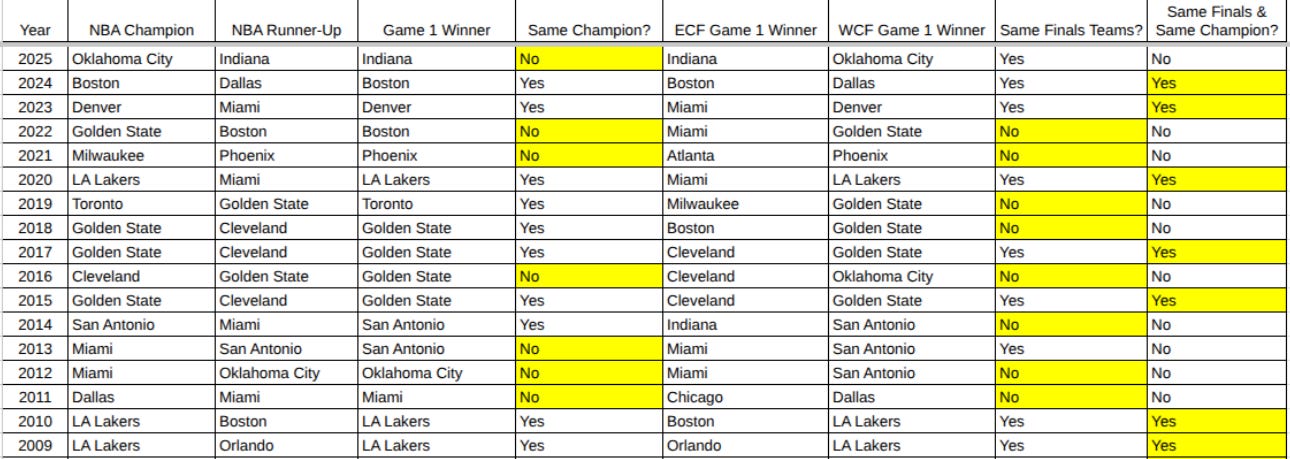
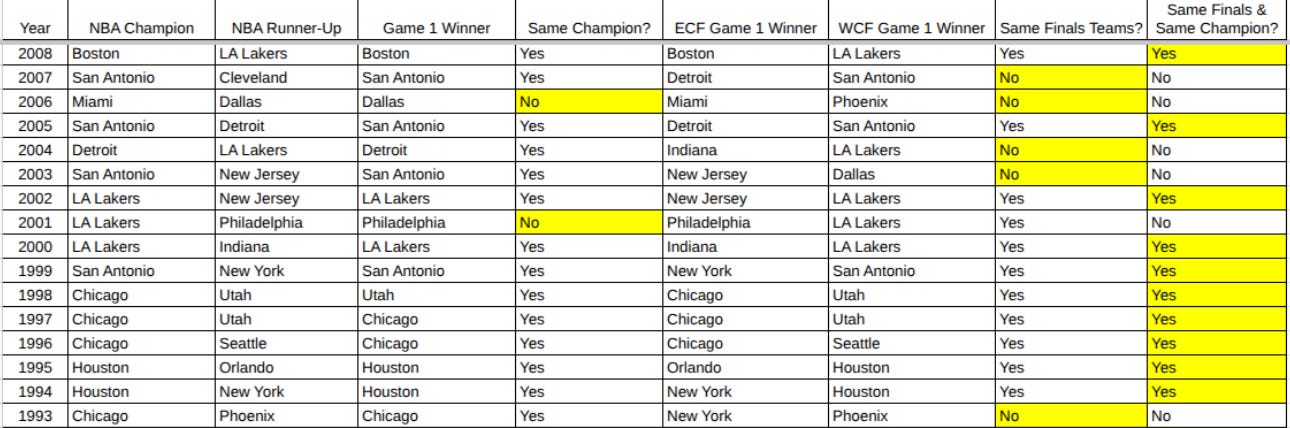
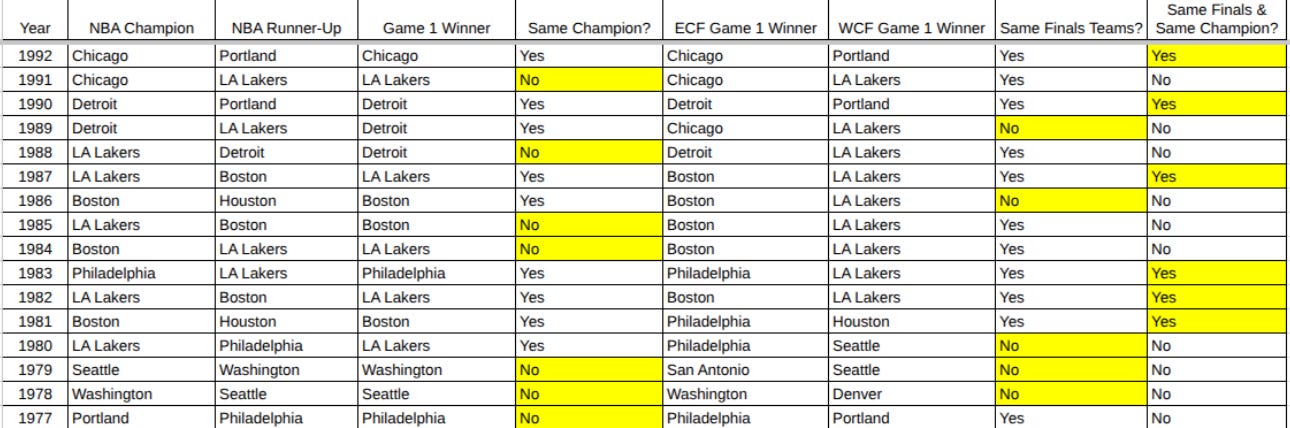
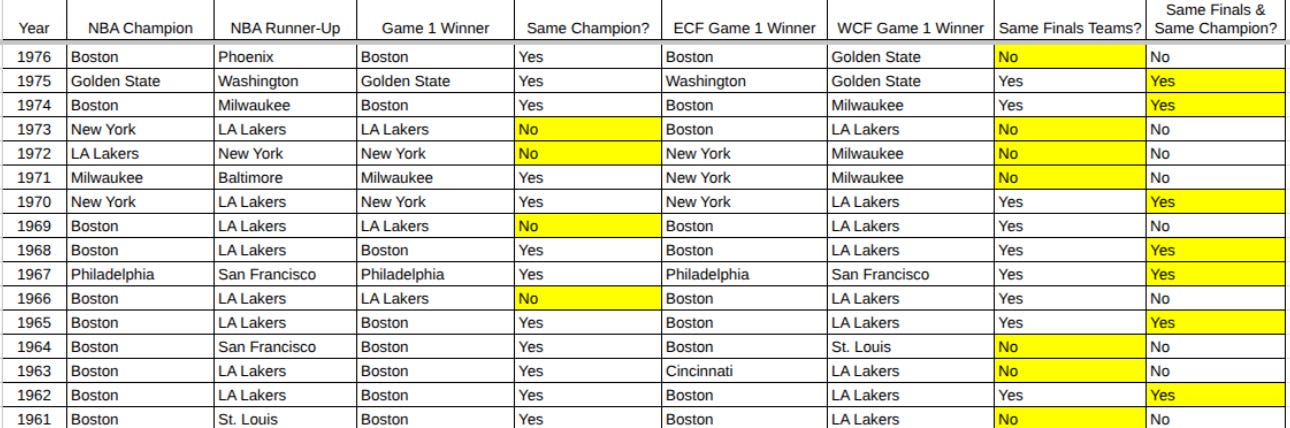

Thanks for reading, Go Duke!
I left out 1950, the NBA’s first season, because those playoffs featured three division finals. The Syracuse Nationals advanced to the NBA Finals, while Minneapolis and Fort Wayne won the other two divisions before Minneapolis defeated Fort Wayne for the right to play Syracuse. The Minneapolis Lakers won the first ever NBA title with a 4-2 series win over the Syracuse Nationals (and the Lakers did win Game 1).
As it turns out, at least one of the teams to make the Finals remained the same every year.
Instead, it would have been Cleveland vs. Oklahoma City in 2016 and Boston vs. Golden State in 2018.
Although OKC lost Game 1 of the WCF in 2012, so it would have been Miami vs. San Antonio instead - and San Antonio would have played Indiana in the 2014 Finals instead of Miami.
Which is not to say that Celtics/Lakers rivalry in the 1980’s wasn’t awesome already. I used to record those games too (ESPN Classic, also awesome) - and I will always wish I got to see a game in the old Boston Garden.
Of course, this Suns/Celtics triple overtime game was a Game 5, so we wouldn’t have gotten that one anyway in this scenario. That also applies to Magic’s Game 6 clincher in 1980, and Ray Allen’s corner three (also Game 6) - both mentioned earlier. I really need to think this through some more….
This leaves Bill Russell with “only” eight NBA Championships.
Growing up, I can remember some rumbling/grumbling about a possible three-game series for the two championship teams in college basketball. And let’s be honest, a Monday/Wednesday/Friday best-of-three National Championship would be awesome, but there’s no chance I’d want the format to change at this point and no chance I wish it had been a series format all along.